
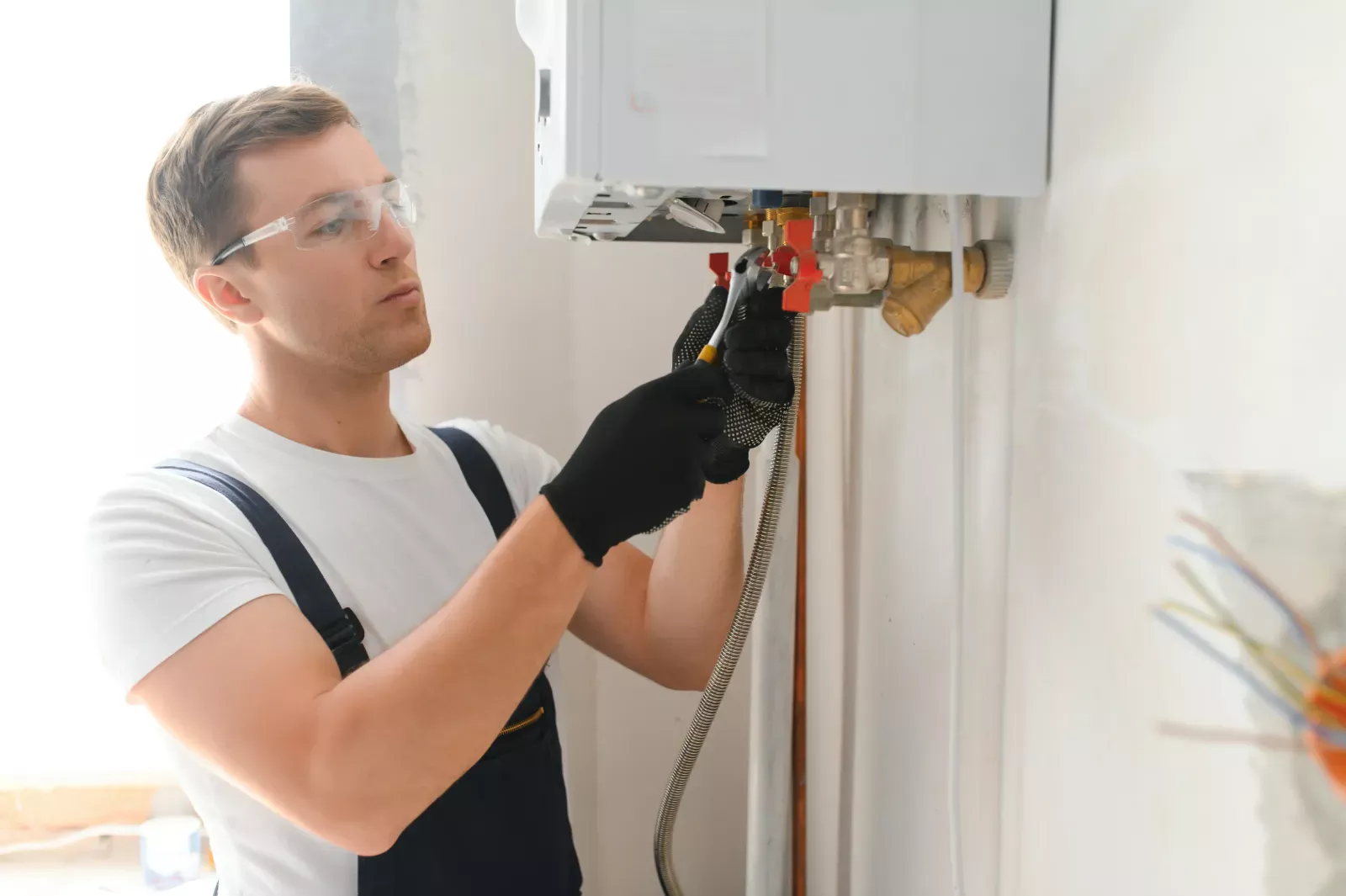
There is nothing worse than waking up on a freezing morning to a cold house and no hot water. Boilers are most likely to fail when we rely on them most, and in many cases the cause is something simple you can check yourself in a few minutes. This checklist covers the most common problems, what you can safely do, and the point at which you should stop and call a Gas Safe registered engineer.
Safety first: gas and carbon monoxide
Before anything else, know the warning signs. If you smell gas, do not turn any switches on or off, do not use a naked flame, open the windows and doors, turn off the gas at the meter, and call the National Gas Emergency Service free on 0800 111 999.
Carbon monoxide is odourless and deadly. Fit an audible CO alarm near the boiler and in bedrooms. If the alarm sounds, or you feel dizzy, sick or have headaches, get everyone outside into fresh air and call the emergency line. A boiler with a yellow or orange flame instead of a crisp blue one, or with black marks around it, should be switched off and checked by an engineer.
Check 1: power, thermostat and timer
It sounds obvious, but a surprising number of call-outs come down to settings. Make sure the boiler is switched on at the wall and the display is lit. Check that the thermostat is set a few degrees above the current room temperature, and that the timer or programmer is not in an "off" period. If you have a smart thermostat, check it has battery power and a connection. Replace the batteries in a standard thermostat if the screen is blank.
Check 2: boiler pressure
Most combi boilers have a pressure gauge on the front. When the heating is cold, the needle should sit between 1 and 1.5 bar, in the green zone. If it falls below 1 bar, the boiler may lock out and show a fault code.
To top it up, find the filling loop, a braided hose with a valve at each end under the boiler. Check the manual for your model. Open the valves slowly until the gauge reads about 1.2 bar, then close both firmly and disconnect the loop if it is removable. If pressure keeps dropping, you probably have a leak somewhere in the system, and that needs an engineer.
If pressure is too high, above 3 bar, do not ignore it. Leave it and call for help.
Check 3: frozen condensate pipe
This is the number one cause of winter boiler breakdowns. Condensing boilers produce acidic water that drains out through a plastic pipe, often running outside to a drain. In freezing weather, that water can freeze and block the pipe. The boiler then shuts down, and you may hear gurgling or see a fault code.
To fix it safely:
- Find the pipe, usually a white or grey plastic pipe about 20 to 32 mm wide, leading outdoors.
- Look for a frozen blockage, which often occurs at a bend or at the open end.
- Pour warm water, not boiling, over the pipe, or hold a warm hot-water bottle or cloth against it.
- Reset the boiler according to the manual.
Never use boiling water, because it can crack the pipe. Once thawed, ask your engineer about insulating the pipe or re-routing it to prevent a repeat.
Check 4: gas supply and other appliances
Check whether other gas appliances, such as the hob, are working. If they are not, there may be a supply problem. If you have a prepayment meter, check you have credit. Look at the meter to see whether it is showing an error. If your supply has been cut off, contact your supplier or distributor.
Check 5: reset once, and only once
Most boilers have a reset button or a reset sequence on the display. If the boiler has locked out, press reset once, wait a few minutes and see whether it fires up. If it fails again, do not keep resetting. Repeated resets can mask a fault that needs fixing, and some faults are safety lockouts that have triggered for a reason.
Prevent breakdowns next winter
Have your boiler serviced once a year by a Gas Safe registered engineer, ideally before autumn. Bleed radiators, consider a magnetic filter to catch sludge, insulate exposed pipes and keep the heating on a low setting during very cold weather or when you are away.
When to call us
If the checks do not get you warm again, or you see any sign of gas, leaks or fault codes you do not recognise, stop and call. Our emergency plumbers are available 24/7, and typically arrive within 30 to 60 minutes. Tell us what has happened and we will help you stay safe until the engineer arrives.